If you have ridden the Alps, done the Pacific Coast Highway, ticked off Route 66 or explored the Scottish Highlands, you already know what a great motorcycle trip feels like. Now imagine a country where a single day's ride takes you across three climates, two languages and about five centuries of history, and where the road ahead climbs higher than anything in Europe or North America.
That country is India, and for riders from the United States, United Kingdom, Canada, France and beyond, it has quietly become one of the most rewarding motorcycle touring destinations on the planet.
It isn't the easiest place to ride. That's exactly why it belongs on your list. Here are seven reasons India should be your next big ride, along with the practical details you'll need to make it happen.
1. Some of the highest and most dramatic roads on Earth
Let's start with the headline act. The Indian Himalayas are home to a network of mountain roads that simply have no equivalent anywhere else. The Manali–Leh Highway crosses multiple passes above 4,500 metres (roughly 15,000 feet). Khardung La, Tanglang La and Umling La sit higher still, with Umling La topping out above 5,800 metres, well beyond the highest road in the Alps or the Rockies.
Riding here means threading through canyons carved by glacial rivers, crossing improvised bridges, picking a line through water crossings and emerging onto vast high-altitude plateaus where the sky is a deep, almost violet blue. The scenery shifts from alpine forest to barren moonscape to turquoise lakes like Pangong Tso, all within a few days of riding.
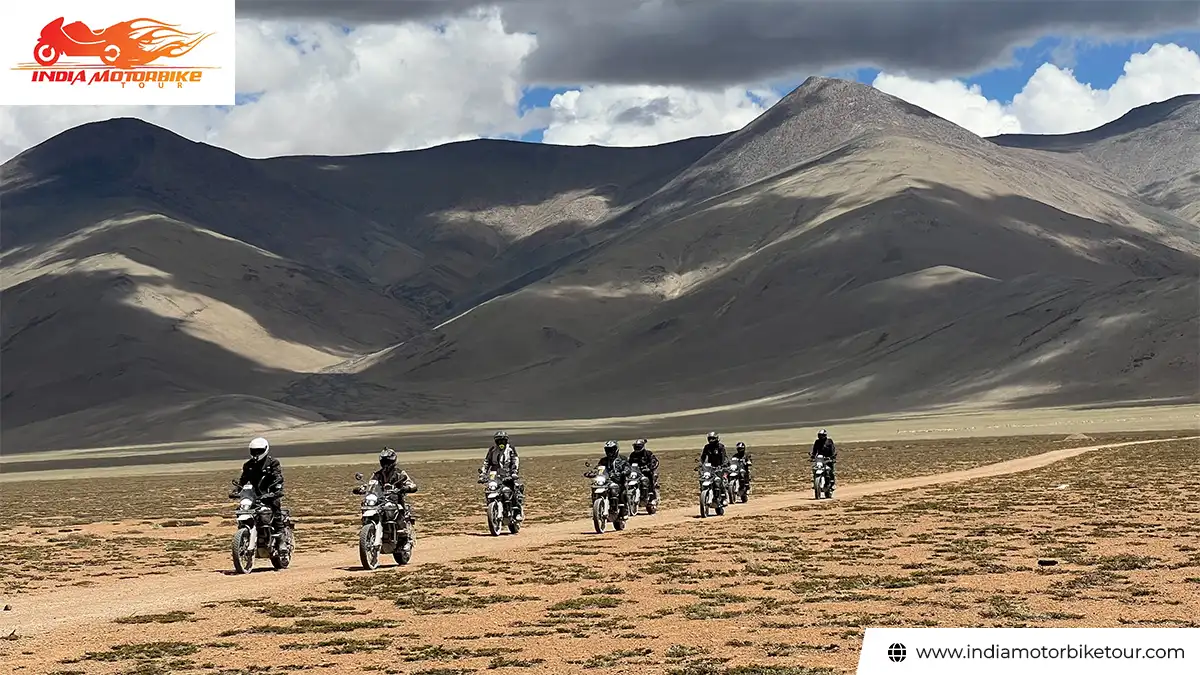
For many international riders, the Himalayas are the whole point of the trip. A tour like the Indian Himalayas Escapade covers the classic Manali–Leh–Ladakh circuit over roughly two weeks, while the shorter Best of Indian Himalayas is ideal if you can only spare a week or so of annual leave. If you'd rather avoid the busier routes altogether, the Hidden Himalayan Odyssey takes in the remote Spiti Valley, one of the least-visited corners of the range.
Reality check: altitude is real. Any well-designed Himalayan itinerary builds in acclimatisation days, and you should treat those as non-negotiable rather than as wasted riding time.
2. A country that changes completely every few hundred kilometres
Here's what surprises first-time visitors most: India isn't one destination. It's a dozen wildly different ones stitched together by roads.
The Himalayas are only the northern chapter. Head south-west and you reach Rajasthan, where the tarmac cuts across the Thar Desert between medieval forts, blue-painted cities and palaces that still host royal families. A Rajasthan Motorbike Tour links Jaipur, Jodhpur, Jaisalmer, Udaipur and Pushkar, with a detour to the Taj Mahal at Agra. The riding is gentler than the mountains, but the cultural density is off the charts.
Go further south still and everything changes again. Kerala and the Western Ghats offer misty hill roads through tea plantations and cardamom estates, then drop down to palm-fringed backwaters and the Arabian Sea coast. The Land of Spices & Coconuts tour from Kochi captures this side of India perfectly: lush, green, relaxed and utterly unlike the arid north.
Three regions, three completely different riding experiences, one country.
3. Riding a Royal Enfield where it belongs
For riders from the UK, there's something poetic about this one. Royal Enfield started life in Redditch, Worcestershire, before production moved to Chennai in the 1950s. Today the brand is fully Indian, and its bikes are practically the national vehicle of the mountains.
Touring India on a Royal Enfield Himalayan is a genuine rite of passage. The bike was purpose-built for these roads: long-travel suspension, an unstressed engine that pulls happily at altitude, and enough ground clearance to cope with rockfall, washouts and the occasional river crossing. It's not fast by North American or European standards, and that's the point. The Himalayan encourages you to slow down, look around and actually experience where you are.
The practical upside is enormous. You don't need to ship your own bike from Los Angeles, London, Toronto or Lyon. You don't need a carnet. You fly in, the bike is waiting, and it's serviced every evening by a mechanic who knows it inside out.
4. Exceptional value for money compared with Europe and North America
Let's talk numbers, because this is where India really separates itself from other bucket-list destinations.
A guided, all-inclusive motorcycle tour in the Alps, Iceland or the American Southwest can easily run to several hundred dollars, pounds or euros per day once you factor in bike hire, accommodation, fuel and food. In India, fully supported tours with a Royal Enfield, hotels, meals, a support vehicle, mechanic and ride leader start from around US $900 for a week in the Himalayas and roughly US $1,750 to $2,400 for the longer two-week expeditions.
That price difference means you can afford to go bigger. Two weeks instead of one. A support truck carrying your luggage instead of overloaded panniers. A mechanic in the van behind you instead of a roadside prayer. Comfortable hotels with hot showers at the end of a tough day rather than whatever you could find.
Day-to-day costs are equally kind to a foreign wallet. A hearty meal at a roadside dhaba costs a couple of dollars. A cup of chai is pocket change. Fuel is inexpensive by Western standards. Your money also flows directly into small family-run guesthouses, local restaurants and village economies along the route, which is the kind of travel most riders want to support anyway.
5. Guided touring takes the stress out of a complex country
India rewards riders, but it doesn't hand things over easily. Traffic has its own logic. Road conditions in the mountains can change overnight. Permits are required for certain border regions. Signage is patchy, and outside the cities English is not always widely spoken.
You can absolutely tackle all of that solo, and plenty of people do. But for a first trip, especially one that's eating up precious vacation days, a guided tour changes the equation completely. A good ride leader knows which pass has just been cleared of a landslide, which guesthouse in a remote village actually has hot water, and how to get a group of foreign riders through a police checkpoint without losing an hour.
Riders who have toured with a local outfit frequently mention this as the decisive factor. When unprecedented rain closed the roads around Leh in 2025, groups with experienced local guides were re-routed via Hanle and Umling La and still completed a full tour, while independent travellers were stuck in town waiting for the airport to reopen.
If you're weighing up the options, the blog post on guided vs. self-guided motorcycle tours in India lays out the pros, cons and pricing of each approach frankly, including when going solo makes more sense.
6. The culture, the food and the people are half the adventure
On most motorcycle tours, the ride is the highlight and everything else is filler. In India, it's a toss-up.
Every stop is an event. A chai break at a roadside stall turns into a twenty-minute conversation with a truck driver who wants to know about your bike and your hometown. A monastery visit in Ladakh becomes a lesson in Tibetan Buddhism from a monk who has lived there for forty years. A fort in Rajasthan reveals a history of Rajput warriors, Mughal emperors and British colonial politics that most Western visitors never learned in school. For riders with a particular interest in the region's spiritual heritage, The Route of Buddhism tour deliberately weaves monasteries, festivals and remote Buddhist villages into the riding.
Then there's the food. Riders burn through calories and need regular, satisfying stops, and India delivers on every front. In the north it's parathas, dal and butter chicken; in the mountains it's Tibetan-influenced momos and thukpa; in Rajasthan it's laal maas and rich vegetarian thalis; in Kerala it's fish curry, appam and the freshest coconut you'll ever taste. Every region has its own cuisine, and the best of it is usually served in the most modest-looking places.
Above all, there's the hospitality. Indian warmth toward guests isn't a tourism slogan; it's a deeply embedded cultural value. You'll be invited into homes, offered food you didn't order and treated as a welcome guest rather than a walking wallet. Riders from Australia, Belgium, Spain, the UK and the US who have toured the country consistently describe the people they met along the way as the thing they remember most.
7. It will change how you ride, and how you see the world
Touring India teaches you things about riding that smooth Western roads never will. You learn to read traffic rather than trust it. You learn patience when a herd of goats occupies the only road for ten minutes. You learn to keep your eyes far ahead for the pothole, the oncoming truck, the cow, the washout. You come home a smoother, calmer and far more aware rider than you left.
More than that, it recalibrates your sense of what's possible. After you've crested a 5,000-metre pass in the snow, ridden through a desert sandstorm and navigated a Kerala fish market on two wheels, a wet weekend in the Peak District or a summer loop through Vermont feels comfortably manageable.
And there's the intangible part that every rider mentions but few can explain. India gets under your skin. The scale of the landscapes, the intensity of the colours, the sheer aliveness of the place stay with you long after the jet lag fades. Most people who tour India once are already planning their return before they've unpacked.
Practical planning for riders from the US, UK, Canada and Europe
A few things to sort before you book:
When to go. The Himalayas are rideable from roughly June to September, when the high passes are open. Rajasthan and South India are at their best from October to March, avoiding both the monsoon and the fierce pre-monsoon heat. Check the tour calendar for fixed departure dates across all three regions.
Visa. Citizens of the US, UK, Canada, France and most EU countries can apply for an Indian e-Visa online before departure. It's a simple process, but allow a few days for approval.
Licence. Bring your home motorcycle licence and an International Driving Permit. Both are essential, and your travel insurance will almost certainly require them.
Permits. Parts of Ladakh and Himachal near the border require Inner Line or Protected Area Permits. A guided tour handles these for you; independent riders will need to arrange them in Leh or Manali.
Insurance. Make sure your policy covers motorcycling, ideally with no engine-size restriction, and high-altitude travel. Many standard travel policies exclude both by default.
Gear. Bring your own helmet, jacket, gloves and boots; the quality and fit of rental gear is always a gamble. Pack layers. In the Himalayas you can go from 30°C in Manali to below freezing on a pass in the same day.
Fitness and experience. Himalayan routes are best suited to riders with solid experience, ideally including some gravel or off-road time. Rajasthan and Kerala are more forgiving and make excellent first trips. If you're unsure which suits you, the team's practical information guide for planning an India motorcycle tour is a good place to start, and you can browse rider photos from every route in the gallery.
Ready to make it your next big ride?
Motorcycle touring in India isn't a relaxing holiday. It's demanding, unpredictable, occasionally chaotic and utterly unforgettable. It offers the highest roads you'll ever ride, a cultural richness that no other destination can match, and a price point that makes a genuine two-week expedition realistic for ordinary riders on ordinary budgets.
If that sounds like the kind of trip you've been waiting for, take a look at the full range of motorcycle tours across India, or get in touch with the team, who are based in Manali and have been guiding international riders through the Himalayas, Rajasthan and South India for well over a decade.
The passes are open. The Royal Enfield is fuelled. All that's missing is you.